The research is clear: what happens in the gym is only half the equation. Here’s what the science actually says about sleep and muscle recovery.
By the Live2Lift Team·June 2026·8 min read
You track your macros. You log your sets. You argue about progressive overload on the internet. But if you’re consistently sleeping six hours or less, you are actively working against every rep you put in. For intermediate lifters — people who’ve moved past newbie gains and are chasing real progress — sleep isn’t a nice-to-have. It’s the mechanism by which training actually works.
The research on sleep and muscle recovery has expanded dramatically in recent years, and the findings are sobering. This article breaks down the physiology, the data, and — most importantly — what to do about it.
What Actually Happens While You Sleep
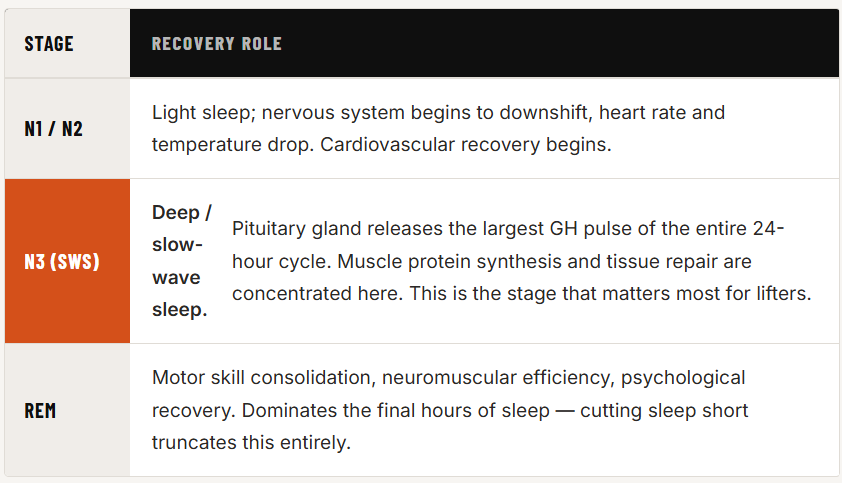
Training creates the stimulus. Sleep provides the adaptation. During the night, your body cycles through four sleep stages roughly every 90 minutes. Each stage plays a distinct role in recovery — and you need all of them.
The Growth Hormone Window
Research published in the Journal of Clinical Endocrinology and Metabolism has documented that human growth hormone (HGH) secretion is closely coupled to slow-wave sleep duration and intensity.[2] The single largest GH pulse of the day occurs within the first 90 minutes of falling asleep — during that first deep-sleep cycle. Disrupt that window with a late bedtime, alcohol, or excessive screen light, and the pulse is blunted. It doesn’t reschedule.
The mechanism runs like this: HGH travels to the liver and muscle tissue, where it stimulates production of insulin-like growth factor 1 (IGF-1). IGF-1 then activates the mTOR signaling pathway — the same molecular switch your protein intake is trying to flip — and triggers satellite cell activation for muscle repair and growth.[2] A 2025 study published in Cell mapped the specific neuroendocrine circuit driving this GH release during deep sleep, confirming that the brain’s sleep-state directly controls the hormonal environment for muscle anabolism.[4]
What Sleep Deprivation Does to Your Gains
The data here is direct and it isn’t subtle.
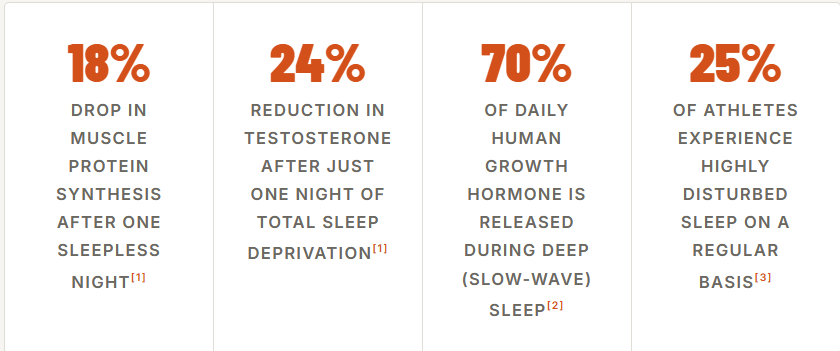
A controlled study published in Physiological Reports (Lamon et al., 2021) found that a single night of total sleep deprivation reduced postprandial muscle protein synthesis by 18% — alongside a 24% drop in testosterone and a 21% rise in cortisol.[1] In practical terms: you trained, you ate your protein, and your body used roughly one-fifth less of it to build muscle. The cortisol spike also shifts the balance from anabolic to catabolic — the body begins breaking down muscle tissue rather than repairing it.
“Chronic sleep deficiency exacerbates catabolic processes through elevated cortisol and decreased testosterone and GH, thereby limiting protein synthesis and muscle recovery capacity.”
A 2025 systematic review and meta-analysis covering 45 studies found that sleep deprivation significantly impaired aerobic endurance, explosive power, maximum force, speed, and skill control in athletes.[5] A 2024 systematic review in Sleep and Breathing further confirmed that impairments are most pronounced after multiple consecutive nights of restricted sleep — meaning the “I’ll catch up on the weekend” approach doesn’t work the way most lifters assume.[6]
Sleep Restriction Is Cumulative
The 2024 review found that grip strength was unaffected after a single night of partial restriction, but declined measurably after three consecutive nights.[6] For intermediate lifters training 4–5 days per week, this matters: a week of poor sleep leading into a heavy squat session is a week of reduced output and elevated injury risk. A 2026 review in Current Pulmonology Reports noted that even a reduction of just 1–2 hours per night can impair speed, explosive power, reaction time, and accuracy — while simultaneously slowing neuromuscular recovery.[7]
How Much Sleep Do You Actually Need?
General population guidelines cite 7–9 hours. For people under significant training loads, the evidence tilts toward the higher end. A consensus statement cited in a 2024 narrative review found that habitual sleep durations in athletes average at or above 7 hours — but roughly half experience sleep disturbances, and 25% suffer highly disturbed sleep on a regular basis.[3]
The more useful framing for intermediate lifters isn’t “how much” but “how complete.” Targeting 5–6 full 90-minute sleep cycles — which translates to roughly 7.5 to 9 hours — ensures you’re spending adequate time in both slow-wave and REM sleep. Cutting to 6 hours truncates the REM-heavy final cycles entirely, costing you motor pattern consolidation and neuromuscular recovery.[8]
Evidence-Based Actions to Optimize Sleep
A 2023 systematic review in Sports Medicine – Open concluded that sleep interventions consistently improve physical strength, speed, cognitive performance, reaction time, and mental health in athletes — confirming that sleep quality is trainable, not just fixed biology.[9] A 2024 narrative review further endorsed a set of evidence-backed strategies that work synergistically.[8]
Consistency Over Duration
Going to bed at varying times disrupts your circadian rhythm and, critically, shifts when growth hormone is released. A fixed bedtime — within a 30-minute window every night — protects the early-night GH pulse and stabilizes cortisol patterns. This single change is the highest-leverage sleep intervention for most lifters.
Thermal Environment
Core body temperature must drop to initiate and sustain slow-wave sleep. A bedroom temperature of 16–18°C (60–65°F) is the research-supported sweet spot. Sleeping cool is not a comfort preference — it’s a physiological requirement for maximizing time in the stages where recovery happens.
Screen and Light Discipline
Blue-spectrum light suppresses melatonin and delays the onset of slow-wave sleep. Implementing a 60-minute screen curfew before bed protects the hormonal cascade that precedes deep sleep. This is especially relevant for lifters who wind down by watching training content or scrolling nutrition forums.
Late-Night Training
Evening training elevates adrenaline, cortisol, and core body temperature — all of which oppose sleep onset. If you must train late, allow at minimum 90 minutes between training and bed, and consider a longer wind-down routine. Research cited in a 2026 athlete sleep hygiene review found that morning or afternoon training actually strengthens the nighttime GH release.[10]
Nutrition Timing and Supplementation
A 2024 Nutrition Society review identified several dietary strategies with an established evidence base for improving sleep quality in athletes: casein protein before bed (slow-release amino acids during the GH window), tart cherry juice (a natural melatonin source with antioxidant properties), kiwifruit, and magnesium.[11] Magnesium is particularly well-supported — it enhances melatonin secretion and acts as a GABA agonist, promoting neural relaxation. For lifters already likely to be in a magnesium deficit from sweating, magnesium glycinate or L-threonate before bed is a low-cost, well-tolerated intervention. Avoid alcohol — it fragments slow-wave sleep and directly blunts the GH pulse even when total sleep time appears normal.[10]
Your Sleep Optimization Checklist
Apply these systematically before adding any other recovery tool:
- Set a fixed bedtime within a 30-minute window every night — including weekends
- Target 7.5–9 hours in bed (5–6 complete 90-minute sleep cycles)
- Keep bedroom temperature between 16–18°C (60–65°F), dark and quiet
- Implement a 60-minute screen curfew; shift toward dim, warm lighting in the final hour
- Avoid alcohol within 3 hours of bed — it destroys slow-wave sleep architecture
- Finish training at least 90 minutes before bed; prefer morning or afternoon sessions when possible
- Consider 200–400 mg magnesium glycinate 30 minutes before bed if sleep quality is poor
- Experiment with casein protein or tart cherry juice in the pre-sleep window
- Address caffeine cutoff — a conservative rule is no caffeine after 1–2 PM
The Bottom Line
Every other recovery strategy — ice baths, massage guns, foam rollers — works at the margins. Sleep is the mechanism. It’s where growth hormone is released, where protein synthesis happens, where testosterone is restored, and where the neural patterns from your training are locked in. For intermediate lifters, the difference between 6 hours and 8 hours of quality sleep is measurable in reps, in body composition, and in injury rates.
You wouldn’t skip your protein. Don’t skip your sleep.
References & Further Reading
- Lamon, S. et al. (2021). The effect of acute sleep deprivation on skeletal muscle protein synthesis and the hormonal environment.Physiological Reports.PubMed →
- Mattress Miracle / Journal of Clinical Endocrinology and Metabolism. Sleep and Muscle Growth: HGH, IGF-1, and the mTOR Pathway.Read more →
- Godos, C. et al. (2024). Implications of sleep loss or sleep deprivation on muscle strength: a systematic review.Sleep and Breathing.Springer →
- Shi, Y. et al. (2025). Neuroendocrine circuit for sleep-dependent growth hormone release.Cell.Cell.com →
- Systematic review and meta-analysis on effects of sleep deprivation on sports performance and perceived exertion (2024–2025).PMC / NCBI.PMC →
- Godos, C. et al. (2024). Sleep loss and muscle strength systematic review.Sleep and Breathing, Springer.Springer →
- Dimitriou, L. et al. (2026). Sleep and Sleep Disorders in High-Level Athletes: A Scoping Review.Current Pulmonology Reports, Springer.Springer →
- Narrative Review: Sleep Restriction Causes and Consequences, Monitoring, and Interventions (2025).PMC / NCBI.PMC →
- Vitale, J.A. et al. (2023). The Impact of Sleep Interventions on Athletic Performance: A Systematic Review.Sports Medicine – Open, Springer.Springer →
- EFX Sports. (2026). The Athlete’s Guide to Sleep Hygiene.Read more →
- Rennie, C. et al. (2024). Sleep and nutrition for athletes.Proceedings of the Nutrition Society, Cambridge Core.Cambridge →
- Kolbe, I. et al. (2025). Sleep and Athletic Performance: A Multidimensional Review of Physiological and Molecular Mechanisms.MDPI Journal of Clinical Medicine.MDPI →